You Won’t Believe What Happens at Crete’s Village Festivals
If you think Greek island life is just beaches and ruins, think again. I dove into Crete’s heart during its local festivals—where music spills into cobbled streets, grandmas dance with ouzo in hand, and the smell of slow-roasted lamb fills the air. This isn’t tourism; it’s living. These celebrations aren’t staged for cameras—they’re raw, joyful, and deeply rooted in tradition. Let me take you where guidebooks don’t: into the pulse of real Cretan life. Here, time slows, laughter echoes from stone walls, and strangers become companions by the end of the night. More than mere events, these village festivals are living threads connecting generations, faith, and land in a rhythm unchanged for centuries.
The Soul of Crete: Why Festivals Matter Beyond Tourism
Cretan village festivals, known locally as panigiria, are far more than seasonal merrymaking. They are the beating heart of community life, where history, faith, and identity converge in a single night of music, food, and dance. Rooted in both religious observance and agricultural cycles, these gatherings mark feast days of patron saints, the harvest of olives, or the first bloom of wild thyme on the hillsides. Each festival carries a story—sometimes of survival, sometimes of gratitude, always of belonging. Unlike the curated performances found in tourist centers, these events are not designed for outside consumption. They exist because the people need them, not because visitors expect them.
What sets these festivals apart is their authenticity. In a world where cultural experiences are often packaged and sold, Cretan panigiria remain unpolished and unapologetically real. There are no timed entry tickets, no souvenir stalls crowding the square, no choreographed acts rehearsed for applause. Instead, there is spontaneous dancing, elders singing hymns from memory, and children chasing each other between wooden tables set up in the village center. These moments are not preserved behind glass—they are lived, breathed, and passed down through generations. The resilience of these traditions reflects the spirit of Crete itself: proud, independent, and deeply connected to its past.
Moreover, these festivals serve as a quiet resistance to the homogenization of travel. While coastal resorts cater to international tastes with generic nightlife and imported music, inland villages hold fast to their customs. By participating in a local panigiria, travelers encounter a version of Greece that resists commodification. The music is not background noise—it is a language. The food is not a dish—it is a legacy. And the people are not performers—they are hosts, welcoming guests into their world on their own terms. This is not tourism as transaction; it is travel as transformation.
Finding the Real Ones: Choosing Which Festivals to Experience
For travelers seeking an authentic experience, the challenge lies in knowing where—and when—to go. Not all festivals in Crete are created equal. While major towns like Heraklion and Chania host large, well-publicized events, these often cater to tourists with polished stages and scheduled acts. The true essence of Cretan celebration thrives in the smaller, remote villages scattered across the island’s rugged interior. Places like Anogia, Sfakia, and Zaros may not appear on every itinerary, but they offer the most immersive and heartfelt experiences.
Timing is crucial. Most village festivals align with the Greek Orthodox calendar, particularly the feast days of local saints. Agios Minas, the patron saint of Heraklion, is honored in late August, but smaller villages celebrate their own protectors throughout the summer and early autumn. Others coincide with harvest seasons—late September for grapes, October for olives—when the air is rich with the scent of crushed fruit and the mood turns celebratory. To find these events, travelers can consult regional tourism offices, local church bulletins, or community-run websites that list panigiria by village and date. Social media groups focused on Cretan culture also provide up-to-date information, often shared by residents themselves.
Another key to authenticity is discretion. The festivals that draw the fewest outsiders are often the most genuine. A simple rule of thumb: if an event is heavily advertised online with English-language brochures and shuttle buses, it may have been adapted for mass appeal. In contrast, the festivals that require a winding mountain drive, a greeting at the village square, and a willingness to blend in are likely to offer a deeper connection. These are not spectacles to watch—they are moments to join. And the reward for making the effort is not a photo op, but a memory etched in warmth, rhythm, and shared humanity.
A Day in the Life: What to Expect at a Cretan Festival
A Cretan village festival unfolds slowly, like the rising heat of a summer afternoon. The day often begins with a sense of quiet anticipation. Church bells toll in the early hours, calling the faithful to a special service honoring the saint of the day. The small stone chapel, sometimes centuries old, fills with villagers in their best clothes—men in dark trousers and crisp shirts, women in long skirts and embroidered blouses. Incense swirls through the nave as the priest leads the congregation in Byzantine chants, their voices echoing off ancient frescoes. This is not a performance; it is devotion, a sacred prelude to the celebration ahead.
By mid-afternoon, the village square begins to transform. Long wooden tables are set up under olive trees, draped with white cloths and adorned with simple flower arrangements. Children dart between the benches, playing traditional games like “koukouvagia” (an owl-and-mouse chasing game) or tossing knucklebones on flat stones. Musicians arrive, unpacking their instruments—lyres with worn wood, laouta (Cretan lutes), and sometimes a tsampouna (a type of bagpipe). They tune quietly at first, testing strings and reeds, until the first bold note cuts through the air like a spark.
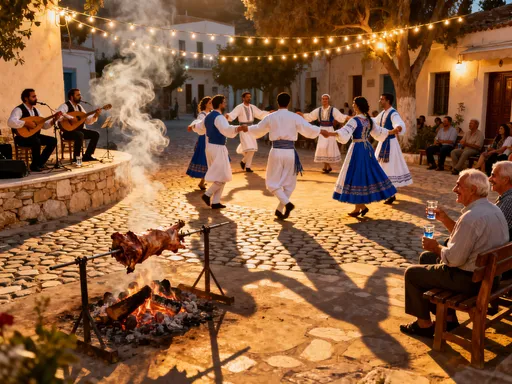
As the sun dips behind the mountains, painting the sky in hues of amber and rose, the energy shifts. The scent of grilled meat rises from open fires where whole lambs and goats roast slowly on spits. Women in aprons move between pots, stirring stews and arranging plates of dakos—barley rusks topped with tomato, feta, and golden Cretan olive oil. Raki, the clear, potent spirit distilled from grape pomace, is poured into small glasses, passed from hand to hand. There is no formal program, no MC announcing acts. The music starts when someone begins to sing, and the dance begins when someone stands and moves.
Nightfall brings the heart of the festival. Lanterns glow above the square, and the lyre’s melody grows stronger. Elders sit at the edges, clapping in rhythm, their eyes bright with memory. Young people form circles, stepping forward and back in traditional dances. Strangers are pulled into the line, their missteps met with laughter and encouragement. The air hums with life—voices singing in unison, feet stamping on stone, the occasional toast shouted in Greek. Time loses its urgency. There is only now, here, together.
Music, Dance, and the Spirit of Resistance
Cretan music is not merely entertainment; it is memory in motion. The lyre, often carved from fig or walnut wood, carries within its strings centuries of joy, sorrow, and defiance. Traditional dances like the pentozali—a fast, leaping dance originating in the mountain villages—and the siganos—a slow, solemn circle dance—were born in times of occupation and hardship. The pentozali, with its high steps and sharp turns, was once danced by rebels as both a physical exercise and a symbol of resistance against Ottoman rule. The siganos, in contrast, reflects mourning and unity, often performed at religious festivals and funerals alike.
What makes these dances powerful today is not just their history, but their living presence. They are not museum pieces, preserved behind glass. They are taught to children at family gatherings, played at weddings, and revived each summer in village squares. When a local musician strikes up a pentozali, the response is instinctive. Men and women, young and old, form lines and begin to move, their steps precise yet passionate. The rhythm is infectious, built on a 5/8 or 7/8 time signature that feels both unfamiliar and deeply compelling to outsiders.
And here lies one of the most beautiful aspects of Cretan festivals: the open invitation to participate. Visitors are not expected to master the steps. In fact, locals often laugh good-naturedly at clumsy attempts, then gently guide newcomers into the circle. “Come, try!” they say, pulling you in. “It’s not about being perfect—it’s about being here.” Enthusiasm is valued over precision. What matters is the act of joining, of moving together in shared rhythm. This inclusivity is not performative; it is a reflection of Cretan hospitality, where guests are treated as extended family, even if they’ve just arrived.
The music itself tells stories. Songs speak of love and loss, of shepherds in the highlands, of battles fought and freedoms won. Some are centuries old, passed down orally, their lyrics rich with metaphor and local references. Others are newer, composed in honor of a village elder or a fallen hero. Listening closely, one can hear the wind of the White Mountains, the crash of the Libyan Sea, the echo of ancient voices. To stand in a circle, hand in hand, swaying to a song you don’t understand but feel in your bones—that is the essence of connection.
Taste the Tradition: Festival Food That Tells a Story
No Cretan festival is complete without food—and not just any food, but the kind that carries the taste of the land and the labor of the community. The feast is not served in courses or ordered from a menu. It is communal, abundant, and deeply symbolic. At the center of it all is the slow-roasted lamb or goat, cooked over an open fire for hours until the skin crackles and the meat falls from the bone. This is not fast food; it is food made with patience, meant to be shared among dozens, sometimes hundreds, of people.
Beside the meat, tables overflow with dishes that define the Cretan diet: dakos, a humble rusk topped with ripe tomato, crumbled mizithra cheese, and a generous drizzle of olive oil—some of the finest in the world, pressed from olives grown on terraced hillsides. There are bowls of wild greens—horta—boiled and dressed with lemon, foraged from the fields at dawn. Small plates hold dolmades (stuffed grape leaves), tzatziki made with thick sheep’s milk yogurt, and slices of fresh watermelon to cool the summer heat. Bread is baked in wood-fired ovens, its crust crackling under the knife.
What makes this food special is not just its flavor, but its origin. Much of it is grown, raised, or made by the villagers themselves. The lamb comes from a local shepherd’s flock. The cheese is from a family’s own goats. The olive oil is from trees tended for generations. Even the raki, served in small glasses and sipped slowly, is homemade, often distilled in the autumn and shared only on special occasions. There is no branding, no labels—just the pride of self-sufficiency and the joy of giving.
Meals are not rushed. People eat in shifts, making room for others at the table. Children are handed plates by aunties, elders are served first, and visitors are urged to “eat more, eat more!” with genuine insistence. Refusing a second helping can be seen as polite in some cultures, but in Crete, it may be taken as rejection. To accept the food is to accept the hospitality. And in doing so, you become part of the moment—not a spectator, but a participant in a ritual of nourishment and kinship.
How to Join Respectfully: Etiquette for Immersive Travelers
Participating in a Cretan village festival is a privilege, not a right. While locals are famously warm and welcoming, respect is essential. The first rule is to observe before acting. Arrive early, find a quiet spot, and watch how the community moves through the day. Notice when people go to church, how they greet elders, when the music begins. These subtle cues guide your own behavior. Dress modestly, especially if attending a religious service. Women may want to cover shoulders and knees; men should avoid shorts and sleeveless shirts in church settings.
Bringing a small gift is a thoughtful gesture if invited into a home or offered food. A box of sweets from a nearby town, a bottle of wine from your region, or even a simple pack of coffee shows appreciation. Avoid handing money or expensive items—hospitality here is not transactional. Learning a few basic Greek phrases—“kalimera” (good morning), “efharisto” (thank you), “opa!” (an exclamation of joy)—goes a long way. Even mispronounced words are met with smiles, as effort is valued over perfection.
Photography should be approached with care. While it’s natural to want to capture the vibrant scenes, avoid pointing your camera at people without permission, especially during prayer or intimate moments. If you wish to take a photo, a smile and a nod often suffice as a request. Better yet, put the phone away and simply be present. The memory of a shared dance, a toast in raki, a grandmother’s laugh—these are not pixels, but feelings that stay with you.
Most importantly, come with humility. You are a guest in someone’s life, not the center of it. Listen more than you speak. Accept invitations graciously, but don’t demand inclusion. Let the rhythm of the village guide you. When you do dance, do it with joy, not self-consciousness. When you eat, do it with gratitude. And when you leave, do it with a quiet heart, carrying not souvenirs, but a deeper understanding of what it means to belong.
Beyond the Party: Why These Moments Change How You See Travel
A Cretan village festival is not just an event to check off a list. It is an invitation to slow down, to connect, to remember why we travel in the first place. In an age of fast itineraries and curated Instagram moments, these celebrations offer something rare: authenticity. They remind us that culture is not something to be consumed, but lived. The music, the food, the dance—they are not performances for an audience. They are expressions of identity, passed down like heirlooms, strengthened by each generation that dares to keep them alive.
For the traveler willing to go beyond the shoreline, Crete offers a different kind of beauty—one found in the wrinkles of an old man’s face as he sings an ancient hymn, in the calloused hands of a woman shaping cheese, in the unscripted laughter of children under a starlit sky. These are not moments engineered for impact. They are real, fleeting, and profoundly human. And in participating, even briefly, you are not just seeing another culture—you are being welcomed into it.
This kind of travel changes you. It softens the edges of haste. It teaches patience, presence, and the value of simple things: a shared meal, a hand on your shoulder, a song sung in a language you don’t understand but feel in your chest. It shifts your perspective from “what can I see?” to “who can I meet?” From “where can I go?” to “how deeply can I experience?”
So if you find yourself in Crete, do not stay only on the coast. Venture inland. Follow the sound of the lyre. Accept the glass of raki. Step into the circle, even if you don’t know the steps. Let the mountains hold you, the music move you, the people welcome you. Because in the end, it is not the places we remember most—it is the moments we truly lived. And in a Cretan village festival, life is not just celebrated. It is felt, shared, and never forgotten.